

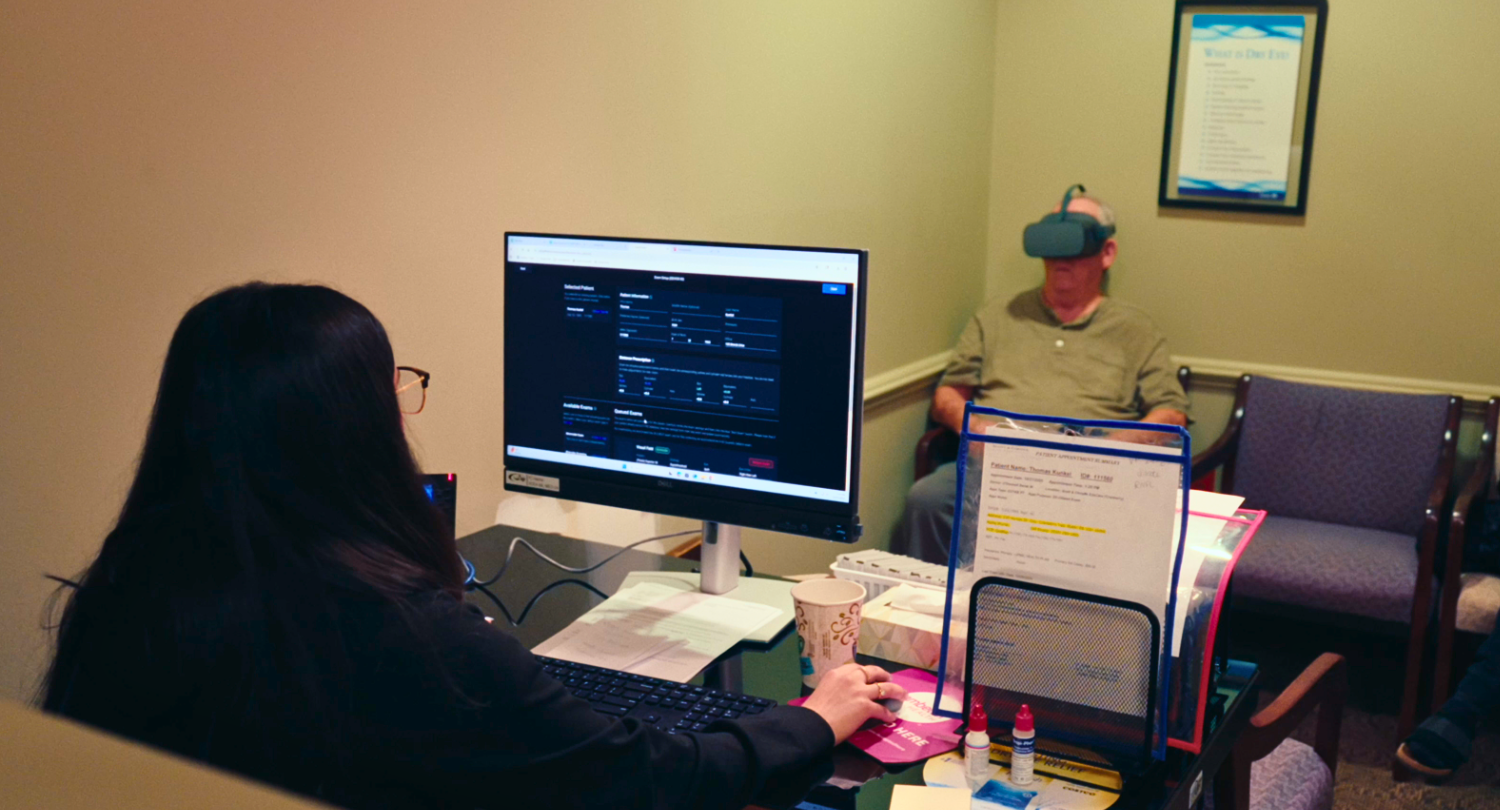
Portable visual field analyzers remain essential tools in modern eye care, offering the same diagnostic precision as traditional perimeters with far greater flexibility. These portable ophthalmic devices enable eye care professionals to deliver comprehensive vision assessments with more flexible patient scheduling and workflows, reaching a broader, more diverse patient population. Whether enhancing efficiency in high-volume practices or extending care to underserved communities, portable perimetry represents a practical and forward-looking investment in the future of vision testing.
What Is a Portable Visual Field Analyzer?
A portable visual field analyzer is a compact device designed to assess a patient’s visual field – the range of vision a person can see while focusing on a central point. Like traditional bowl perimeters and tabletop analyzers, it helps detect and monitor conditions such as glaucoma, retinal disease, and neurological disorders. However, a portable perimetry device offers significant advantages in flexibility and accessibility. Instead of requiring a dedicated testing room and large, stationary equipment, portable analyzers are lightweight and can be used in multiple clinical settings and exam lanes. Many models incorporate virtual reality (VR) or head-mounted displays to simulate the testing environment, enabling reliable threshold testing comparable to standard perimetry. This mobility allows eye care professionals to expand screening capabilities and improve patient comfort and compliance.
Key Features to Look for Before Buying
When choosing a portable visual field analyzer, clinicians should assess several core features that impact diagnostic accuracy, workflow efficiency, and patient experience. This visual field analyzer buying guide includes key considerations to look for, including:
- Accuracy and Reliability: Clinicians rely on precise data to detect and monitor visual field defects; therefore, the device’s algorithms, fixation monitoring, and test reproducibility must be comparable to those of traditional stationary perimeters. Validated clinical studies or peer-reviewed performance comparisons can help confirm diagnostic accuracy and minimize false positives or negatives.
- Ease of Use: A user-friendly interface with intuitive navigation shortens setup and testing time, while clear on-screen instructions or voice guidance can improve patient compliance and reduce the need for technician intervention. For patients, especially older adults or those with limited attention spans, simplified testing protocols and comfortable head positioning contribute to more reliable results.
- EHR System Integration and Interoperability: Integrations with Electronic Health Record (EHR) systems and interoperability with existing practice management software streamline workflows and reduce manual data entry. Devices that support standard file formats, such as DICOM, facilitate secure data exchange and long-term record storage.
- Portability: A truly mobile analyzer should be lightweight, durable, and battery-powered for use in remote settings or satellite clinics.
- Software Updates and AI Capabilities: Regular software updates are essential for maintaining performance and security, while artificial intelligence (AI) features (e.g., automated progression analysis or quality control alerts) can further aid in interpreting results and tracking disease changes over time.
- Accessibility: Portable visual field analyzers are designed for patients with mobility limitations, nonstandard positioning needs, or language barriers help ensure equitable access to testing. Adjustable designs, multilingual interfaces, and clear visual or auditory cues make these devices more inclusive and practical for diverse patient populations.
Benefits of Portable Visual Field Testing
Portable visual field testing is reshaping how clinicians deliver eye care by combining diagnostic precision with mobility and convenience. As these devices become more advanced and widely adopted, they offer tangible benefits for both practitioners and patients. From expanding access to care in remote areas to streamlining clinical workflows, portable visual field analyzers are transforming the traditional boundaries of vision assessment.
Increased Accessibility
Portable visual field testing significantly increases access to vision care by enabling clinicians to conduct screenings outsidetraditional clinical settings. These devices enable access to patients in rural or underserved areas, as well as in nursing homes, rehabilitation centers, and mobile clinics. By reducing the need for specialized testing rooms or large stationary equipment, portable analyzers expand the reach of preventive eye care and facilitate early detection of visual field loss in populations that may otherwise go untested.
Patient Comfort and Compliance
Patient comfort and compliance are also improved with portable visual field testing. The compact design and simplified setup of modern devices often allow patients to be tested while sitting comfortably, without the need for rigid headrests or lengthy fixation times. This can be particularly beneficial for elderly patients or those with mobility challenges. Enhanced comfort tends to result in better engagement, fewer interruptions, and more reliable test results.
Time Savings for Clinicians
For clinicians, a portable visual field analyzer offers considerable time savings. The quick setup process, automated calibration, and shorter test durations streamline the workflow, allowing more patients to be examined in less time. Many portable systems are also designed for use by trained technicians or assistants, freeing doctors to focus on interpretation and treatment planning rather than test administration.
Better Data Flow and Reduced Manual Entry
Improved data flow and reduced manual entry enhance efficiency and accuracy in patient record management. Portable analyzers that integrate directly with EHR systems automatically transfer results, minimizing transcription errors and ensuring that patient data is readily available for review, comparison, and longitudinal analysis.
Virtual Field’s DICOM 360 Sync was designed to make imaging interoperability effortless. It’s the industry’s first real-time, bi-directional sync engine that connects your imaging devices, EMR/EHR, and PACS for a true zero-touch workflow—no manual uploads, no lost files, and no waiting. Click below to learn more.

Common Use Cases
Portable visual field analyzers are increasingly adopted across clinical and research settings. In private practice, they serve as efficient tools for baseline testing, routine glaucoma monitoring, follow-up testing, and rapid screening when space or patient volume is limited. Their small footprint and ease of setup make them ideal for multi-room practices or locations without dedicated perimetry equipment.
.png)
In telehealth applications, portable analyzers allow clinicians to perform remote visual field assessments and securely share data with specialists for interpretation. This capability supports continuity of care for patients who have difficulty traveling or live in areas with limited access to eye care providers.
In research settings, a portable visual field analyzer enables data collection outside traditional clinical environments, including in community-based studies and multi-site clinical trials. Their standardized testing protocols help maintain consistency while improving logistical efficiency.
Community outreach programs also benefit from these devices, which are used to bring vision screenings directly to schools, nursing homes, and underserved populations. By eliminating the need for stationary equipment, portable analyzers enable earlier detection of visual field loss and connect more patients to follow-up care, ultimately expanding access to essential eye health services.
Cost Considerations
When evaluating the cost of a portable visual field analyzer, it’s essential to explore not only the upfront investment but also the ongoing costs and the potential return on investment (ROI) for your practice.
Many subscription-based portable systems, such as Virtual Field, begin at approximately $179 per device per month when billed annually. For comparison, traditional tabletop perimeters can cost in the tens of thousands of dollars when purchased outright. Financing and monthly subscription models can mitigate cash-flow impact and enable scaling across exam lanes or satellite clinics.

When comparing a portal visual field analyzer to a tabletop mode, hidden costs must also be factored in: staff training to ensure the tabletop perimeter is used correctly, annual or ongoing software license fees (for updates, modules, or AI features), and hardware maintenance or warranty contracts. Even when a provider advertises “no per-test fees,” you should verify that it includes peripheral costs, such as calibration, technician time, or data-migration to your EHR. For example, with Virtual Field, there are no per-click fees, restocking fees, warranty costs, data storage fees, or deductibles.
Finally, ROI must be evaluated realistically. The efficiencies gained translate into revenue. With Virtual Field, performing as few as four exams per month can justify the subscription cost. A study of head-mounted VR visual fields found that procedural cost per test fell, profit margins doubled, and device payoff occurred in just a few months at moderate patient volumes. In short, when cost models, workflow impact, and billing alignment (e.g., CPT codes 92081, 92082, 92083) are aligned, a portable visual field analyzer can deliver significant value to a modern practice.
5 Questions to Ask Before You Buy
Before purchasing a portable visual field analyzer, it’s essential to ask the right questions to ensure the device fits your practice’s needs and long-term goals. A thoughtful evaluation not only protects your investment but also helps guarantee a smooth integration into your daily operations.
To find the right visual field testing equipment and reap the most benefits of portable perimetry, ask yourself these five questions:
- Does it integrate with my current workflow? Compatibility with your existing EHR system, practice management software, and data storage protocols is crucial. A system that easily exports data in standard formats and syncs seamlessly with your digital infrastructure can save time, reduce transcription errors, and improve continuity of care.
- Is it FDA-cleared (in the United States) or Health Canada-approved? These regulatory approvals indicate that the analyzer meets established safety and performance standards. Devices lacking these designations may not be suitable for diagnostic use or may present liability risks.
- How is the company’s customer support and training? Reliable technical support, onboarding assistance, and access to troubleshooting guides or online training can make a significant difference in how efficiently your team adopts and uses the device. Ask about response times, warranty coverage, and availability of live or remote training options.
- Do you have a monthly subscription plan? Some manufacturers offer monthly subscription plans that include software access, updates, and cloud storage, while others sell devices outright. Understanding the total cost of ownership can help avoid unexpected expenses.
- Do you regularly update your software or add new features/exams? Regular updates indicate an ongoing commitment to innovation, data security, and diagnostic accuracy, helping your practice stay current as technology evolves.
The Future of Portable Perimetry
The future of portable perimetry is centered on greater connectivity, automation, and diagnostic precision. AI integration is expected to play a major role in early disease detection by analyzing test patterns over time and identifying subtle changes that may precede noticeable vision loss. Cloud-based reporting will further streamline data management, enabling clinicians to securely access and compare visual field results from any location – supporting teleophthalmology and collaborative care. Enhanced interoperability will ensure seamless data exchange between perimeters, EHRs, and imaging platforms, improving both workflow efficiency and continuity of care. As these technologies continue to advance, portable perimetry is poised to become an even more valuable tool for proactive monitoring and personalized management of visual field disorders.
About Virtual Field
Virtual Field delivers an exceptional eye exam experience. Eye care professionals including ophthalmologists and optometrists examine patients faster, more efficiently, and more comfortably than ever before. Exams include Visual Field, 24-2, Kinetic Visual Field (Goldmann Perimetry), Ptosis, Esterman, Color Vision, Pupillometry, Extraocular Motility (EOM), and more.
